
Over the last eight years of Moonshots, we've explored the work of hundreds of authors, entrepreneurs, scientists, artists, educators, and innovators. We've studied creativity from every angle imaginable. We've looked at the habits of musicians, the methods of filmmakers, the thinking of scientists, the systems of entrepreneurs, and the practices of some of the most creative people who have ever lived.
As we prepare to launch a new Moonshots creativity series, beginning with Steven Kotler's The Art of the Impossible, I wanted to pause and reflect on what we've learned so far.
What surprised me most wasn't how different these thinkers are. It was how often they arrived at the same conclusions.
A legendary music producer, a bestselling novelist, a physicist, an animation pioneer, an educator, a designer, and one of history's greatest entrepreneurs all seem to be pointing toward the same creative truths. Creativity is not a gift possessed by a lucky few. It is a practice. It is a way of approaching problems, ideas, opportunities, and life itself.
In our latest episode, I share eight creative practices that have had the biggest impact on my own work as a founder, advisor, podcaster, writer, speaker, software builder, and lifelong learner.
The Eight Thinkers Behind These Ideas
1. Rick Rubin — Show Up Early and Let Ideas Develop
Episode: The Creative Act
Rick Rubin's approach to creativity is deceptively simple. Show up. Pay attention. Trust the process. One of the most valuable ideas I've taken from Rick is the importance of beginning early and allowing ideas time to mature. Great work rarely appears on demand. Whenever I'm preparing a keynote, building a product, creating content, or solving a difficult client problem, I start earlier than I need to. I immerse myself in the work and then let it sit. Some of my best work has emerged not from forcing creativity but from giving it room to develop.
Read the episode:
https://www.moonshots.io/blog/2024/8/8/the-creative-acy-by-rick-rubin-the-zen-master-of-rock?rq=rick%20rubin
2. Elizabeth Gilbert — Choose Momentum Over Perfection
Episode: Big Magic
Elizabeth Gilbert reminds us that creativity favours action. Perfectionism is often fear wearing a disguise. I see this every week with startup founders who delay launches, products, content, and decisions because they want everything to be perfect. The reality is that creative people create. They ship. They learn. They improve. Progress compounds. Perfection delays.
Read the episode:
https://www.moonshots.io/blog/2021/elizabeth-gilbert-big-magic?rq=elizabeth%20
3. Austin Kleon — Share Small Outputs Consistently
Episode: Show Your Work
Austin Kleon's work is a masterclass in consistency. His message is that big achievements are usually the result of many small outputs shared regularly. Moonshots itself is proof of this principle. The show didn't grow because of one breakthrough moment. It grew because Mark and I kept showing up. Small contributions, delivered consistently over many years, eventually become meaningful bodies of work.
Read the episode:
https://www.moonshots.io/258-show-your-work-by-austin-kleon?rq=austin%20
4. Walt Disney — Dream First, Judge Later
Episode: The Disney Strategy
Many great ideas die because they are judged too early. Walt Disney understood the importance of separating imagination from evaluation. During ideation, the objective is not practicality. The objective is possibility. Creativity requires us to suspend disbelief long enough to imagine something better. Instead of saying "Yes, but," Disney's approach encourages us to ask "What if?"
Read the episode:
https://www.moonshots.io/blog/2021/walt-disney-the-disney-strategy?rq=walt%20
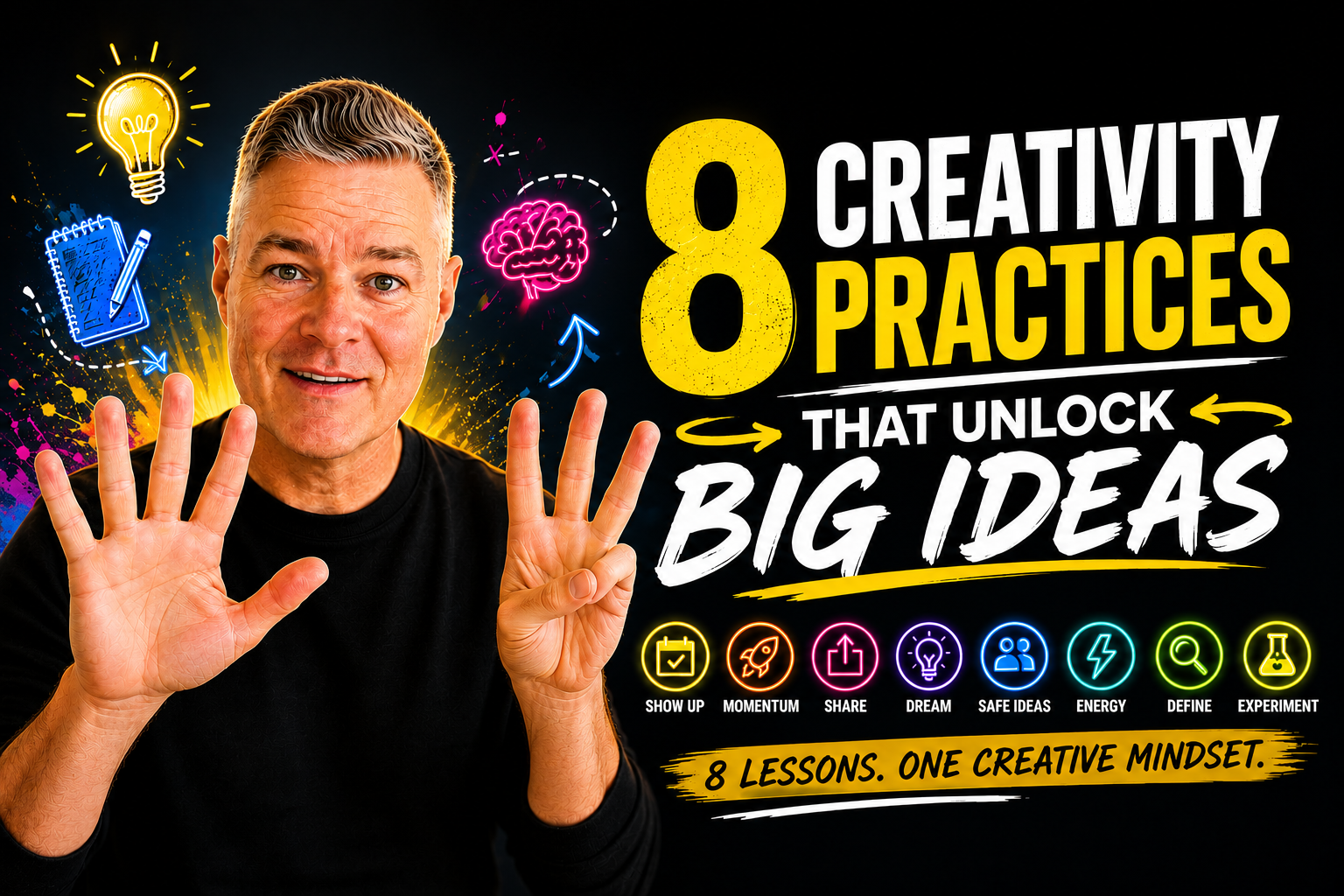
5. Ed Catmull — Create Safety for Unfinished Ideas
Episode: Creativity, Inc.
Ed Catmull's experience building Pixar taught him that ideas are fragile. Great ideas rarely arrive fully formed. They emerge through collaboration, discussion, experimentation, and iteration. Creative cultures create psychological safety. They encourage people to share half-finished thoughts and early concepts without fear of judgement. Innovation depends on environments where ideas can evolve.
Read the episode:
https://www.moonshots.io/episode-08-ed-catmull?rq=ed%20cat
6. Ken Robinson — Follow Your Energy
Episode: The Element
Ken Robinson asks a simple but profound question: What gives you energy? Rather than obsessing over finding your passion, pay attention to what makes time disappear. What work feels meaningful? What activities leave you energised rather than depleted? For me, it's building products, solving strategic problems, creating frameworks, recording podcasts, and helping founders grow. Energy is a powerful signal pointing toward your unique contribution.
Read the episode:
https://www.moonshots.io/episode-179-ken-robinson-the-element?rq=ken%20robinson
7. Albert Einstein — Understand the Problem First
Episode: Albert Einstein Revisited
Einstein believed that understanding the problem was often more important than finding the answer. Most people rush into solutions. Creative thinkers spend more time asking questions, exploring assumptions, and understanding root causes. Whenever I work with founders, I see this repeatedly. The better we define the problem, the clearer the solution becomes.
Read the episode:
https://www.moonshots.io/blog/2022/albert-einstein-revisted?rq=albert%20
8. Bill Burnett & Dave Evans — Prototype Your Way Forward
Episode: Designing Your Life
Bill Burnett and Dave Evans transformed design thinking into a framework for life itself. Their advice is simple but powerful: stop trying to predict the future and start testing it. Run experiments. Talk to people. Explore possibilities. Gather feedback. Most successful careers and businesses emerge through experimentation rather than perfect planning. The future reveals itself one prototype at a time.
Read the episode:
https://www.moonshots.io/take-control-and-dream-big-by-designing-your-life?rq=bill%20burne
The Bigger Pattern
As I reflected on these eight thinkers, I realised they were all describing variations of the same creative process.
Show up consistently.
Start before you're ready.
Choose momentum over perfection.
Break big things into small things.
Share your work.
Create safety for ideas.
Follow your energy.
Obsess over the problem.
Run experiments.
Stay curious.
The biggest myth about creativity is that it belongs only to artists, musicians, writers, or designers. Creativity is available to everyone. It helps us solve problems, build businesses, strengthen relationships, make decisions, and create better lives.
Creativity isn't a lightning strike.
It's a system.
And the good news is that systems can be learned.
Watch the full episode:
https://youtu.be/BUUxRZW_Z0I
